
Blog Categories
Practice Areas
Tags
- discrimination at work New York, EEOC claim New York, employee rights New York, employment discrimination lawyer New York, hostile work environment New York, New York employment discrimination, NYCHRL discrimination, NYSHRL discrimination, workplace discrimination attorney NYC, workplace harassment lawyer NYC
- Blog
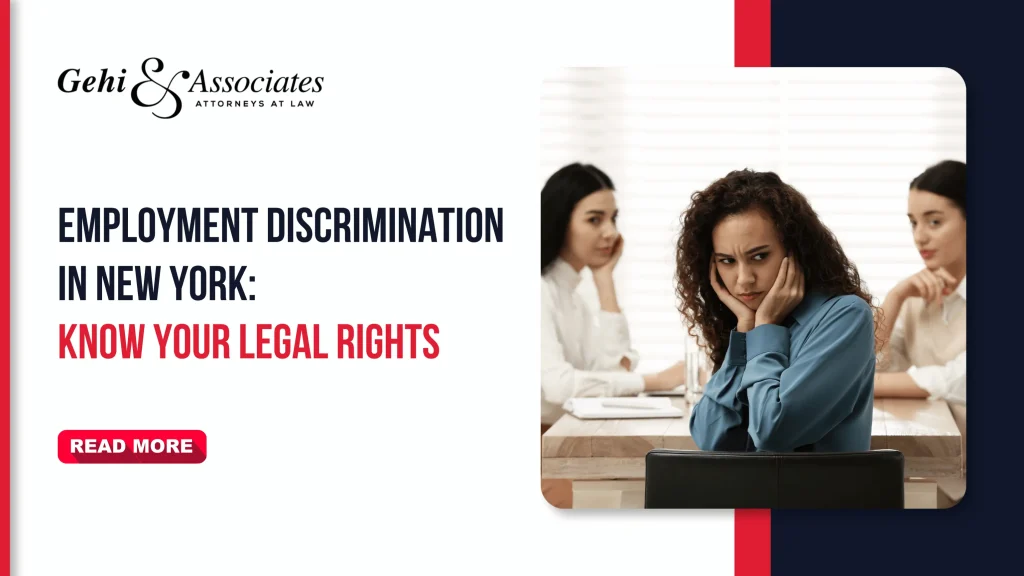
Going to work should never mean enduring discrimination because of who you are. New York gives employees some of the strongest legal protections in the country against unfair treatment on the job.
The challenge is using those protections properly. Three different layers of law overlap. Each one has its own filing deadlines, its own forums, and its own standards of proof.
This guide explains how an employment discrimination lawyer New York based handles these cases in 2026. It covers the role of a workplace discrimination attorney NYC based, the EEOC claim New York process, and what counts as a hostile work environment under current law.
Three Layers of Protection
New York employees are protected by federal law, state law, and in the five boroughs, city law. Each layer is broader than the one below it. The choice of forum often decides the strength of the case.
Federal Law
Title VII of the Civil Rights Act of 1964 is the federal floor. Companion statutes include the Americans with Disabilities Act, the Age Discrimination in Employment Act, and the Equal Pay Act. Most federal laws apply to employers with 15 or more employees.
New York State Human Rights Law
The New York State Human Rights Law, or NYSHRL, applies to nearly every employer in the state, including those with just one employee. The protections are broader than federal law, and the standard for harassment claims is more favorable to employees.
New York City Human Rights Law
The New York City Human Rights Law, or NYCHRL, is one of the most pro-employee discrimination statutes in the country. It applies to employers with four or more employees in New York City. Courts are required to construe it broadly.
Protected Characteristics
Discrimination is illegal when it is based on a protected characteristic. The list grows broader as you move from federal to state to city law.
- Race, color, and national origin.
- Religion, including religious dress and practices.
- Sex, including pregnancy, gender identity, and sexual orientation.
- Age, generally 40 or older under federal law and at any age under New York law.
- Disability, both actual and perceived.
- Marital and familial status, plus caregiver status under New York law.
- Military and veteran status.
- Domestic violence victim status under New York State and City law.
- Criminal and arrest record under New York City law, with limited exceptions.
- Unemployment status under New York City law.
- Weight and height under New York City law.
What Discrimination Looks Like
Discrimination rarely shows up as a memo announcing unfair treatment. It usually appears in smaller, accumulating patterns that an employee has to recognise and document.
Disparate Treatment
An employer treats one employee worse than others because of a protected characteristic. Examples include being passed over for promotions, paid less than peers, or fired after disclosing a pregnancy or disability.
Disparate Impact
A facially neutral policy or practice affects a protected group more harshly. A height requirement that screens out most women, or a strict English-only rule that excludes qualified workers, can be unlawful even without intent.
Harassment and Hostile Work Environment
Unwelcome conduct based on a protected characteristic that alters the terms or conditions of employment. New York law removed the older “severe or pervasive” standard that still applies under federal law.
Under NYSHRL, a hostile work environment claim is actionable when the conduct subjects an employee to inferior terms, conditions, or privileges of employment because of a protected trait. The only employer defense is that the conduct was a petty slight or trivial inconvenience.
Under NYCHRL, the standard is even broader. An employee only needs to show they were treated less well than others because of a protected status. NYC courts construe the statute uniquely broadly in favor of employees.
Retaliation
Punishing an employee for reporting discrimination, participating in an investigation, or supporting a coworker’s claim is itself unlawful. Retaliation claims often succeed even when the underlying discrimination claim does not.
Failure to Accommodate
Employers must provide reasonable accommodations for disability, religion, pregnancy, and certain other protected categories. The duty is triggered when the employee requests an accommodation and the employer is on notice of the need.
How the EEOC Claim New York Process Works
Most employment discrimination cases begin with an administrative agency. An EEOC claim New York filing is one of three main pathways, alongside the NY State Division of Human Rights and the NYC Commission on Human Rights.
Filing the Charge
Federal Title VII claims require filing a charge with the EEOC within 300 days of the discriminatory act in New York. State claims at the Division of Human Rights have a longer window of three years. City claims also run on a three-year clock.
Investigation and Right to Sue
The EEOC investigates the charge and may attempt mediation. The agency issues a Notice of Right to Sue when it finishes. The employee then has 90 days to file suit in federal court.
The state and city agencies follow their own investigative procedures. Election of remedies rules mean that filing with the state agency may bar a later court filing on the same facts, so the choice of forum matters.
Critical Deadlines
- EEOC charge: within 300 days of the discriminatory act for New York employees.
- New York State Division of Human Rights: three years from the act.
- New York City Commission on Human Rights: three years from the act.
- Federal lawsuit after EEOC right to sue: 90 days from receipt of the notice.
- State court NYSHRL lawsuit: generally three years from the act.
- NYCHRL lawsuit in state court: three years from the act.
What You Can Recover
Successful employment discrimination cases can recover a range of damages designed to make the employee whole and deter future violations.
- Back pay covering wages and benefits lost from the unlawful conduct.
- Front pay where reinstatement is not feasible.
- Compensatory damages for emotional distress and reputational harm.
- Punitive damages where the employer’s conduct was willful or reckless.
- Reinstatement to the position, with appropriate accommodations where required.
- Attorney fees and costs in many statutory frameworks.
Damages vary by statute. Federal damages caps apply to Title VII compensatory and punitive damages. State and city law do not have those caps, which is one major reason these forums often produce better outcomes for employees.
What to Do If You Are Facing Discrimination
Document Everything
Keep a detailed, contemporaneous log of incidents, including dates, times, locations, witnesses, and exact words used. Save emails, text messages, and internal communications to personal accounts where lawful.
Report Internally
Use the employer’s internal complaint procedures where they exist. Document the report in writing. Internal reporting can strengthen later claims and trigger anti-retaliation protections.
Get Counsel Early
A consultation with a workplace discrimination attorney NYC based costs nothing in most cases. The earlier the conversation, the more options remain on the table, including evidence preservation and forum selection.
What Employers Typically Argue
- The decision was based on legitimate, nondiscriminatory factors such as performance.
- The conduct complained about was a petty slight or did not rise to a hostile environment.
- The employee failed to use internal complaint procedures.
- The employer responded promptly and effectively when notified.
- The accommodation requested would impose an undue hardship.
- The employee was an independent contractor, not an employee subject to the statute.
Why You Need an Employment Discrimination Lawyer
Discrimination cases combine sensitive facts, technical statutes, and tight filing windows. A capable employment discrimination lawyer New York based navigates all three at once.
Counsel picks the right forum, builds the evidentiary record before evidence disappears, and pressures the employer for an early, fair resolution. They also prepare the case for trial when settlement does not work.
An experienced lawyer also protects the employee from common employer tactics, including pretextual performance reviews, sudden discipline, and pressure to sign separation agreements that waive valuable claims.
No Fee Unless You Win
Employment discrimination cases at our firm are handled on a contingency basis where appropriate. You pay nothing up front. Our fee comes only if we recover compensation for you.
Call our team for a free consultation at Gehi and Associates. We will review your situation in confidence. We will tell you honestly whether the facts support a claim and what the realistic next steps look like.
Connect with us today!
Frequently Asked Questions:
Do I have to file an EEOC claim New York before going to court?
For federal Title VII claims, yes. You must file with the EEOC within 300 days and receive a Notice of Right to Sue before filing in federal court.
State and city law claims under NYSHRL and NYCHRL can often be filed directly in court without exhausting administrative remedies. The choice of forum is one of the early strategic decisions.
What counts as a hostile work environment under New York law?
Conduct based on a protected characteristic that subjects the employee to inferior terms, conditions, or privileges of employment. New York law removed the older “severe or pervasive” requirement. The employer’s only defense is that the conduct was a petty slight or trivial inconvenience.
Can I be fired for filing a discrimination complaint?
It is illegal to retaliate against an employee for filing a complaint or participating in an investigation. Retaliation is a separate, often easier claim than the underlying discrimination claim. Document any adverse action carefully.
What if I am an independent contractor?
Federal Title VII protections generally do not extend to independent contractors. New York State and City laws have expanded coverage to include some independent contractors in certain situations. A lawyer can determine whether you are covered.
Can small employers face discrimination claims?
Yes. The New York State Human Rights Law applies to employers with as few as one employee. The New York City Human Rights Law applies to employers with four or more in the city. Federal law generally requires 15 or more.
What if I work in New York but my employer is based elsewhere?
New York law generally applies to the work performed in New York, even when the employer is based out of state. The protections do not stop at the state line, and remote workers can also be covered depending on the facts.
How long does an employment discrimination case take?
Cases vary widely in length. Some settle within months at the agency stage. Others move to court and take one to three years to resolve. Stronger evidence and clearer damages usually accelerate settlement.
Can a workplace discrimination attorney NYC help if I already signed a severance agreement?
Possibly. Some severance agreements are void or voidable, particularly if signed under duress or without the required statutory disclosures. A lawyer can review the agreement and identify whether claims remain available.
What protected characteristics does New York City add beyond state and federal law?
New York City law uniquely protects against discrimination based on criminal record, unemployment status, caregiver status, height, and weight. These protections are not available under federal law and are often the deciding factor in choice of forum.
How does an employment discrimination lawyer New York charge?
Many employment discrimination lawyers in New York work on contingency or hybrid arrangements. The fee is collected only if the case succeeds. Initial consultations are usually free. Statutory fee-shifting in many cases also lets the employer pay attorney fees if you win.
Related Posts


Free Consultation
For Faster Response
We are Available 24/7
Our law offices in NY offer free virtual and in-person consultations for all legal and immigration matters. To schedule one, please get in touch with us today!