
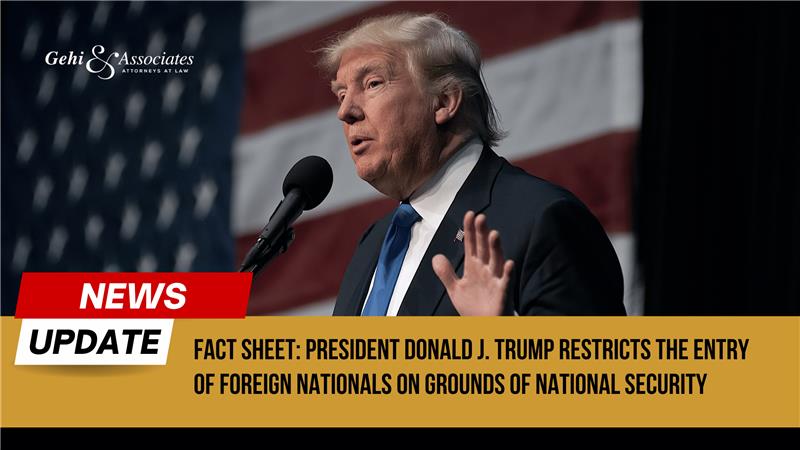
FACT SHEET: PRESIDENT DONALD J. TRUMP RESTRICTS THE ENTRY OF FOREIGN NATIONALS ON GROUNDS OF NATIONAL SECURITY
- Home
- ›
- News Alerts
- ›
- FACT SHEET: PRESIDENT DONALD J. TRUMP RESTRICTS THE ENTRY OF FOREIGN NATIONALS ON GROUNDS OF NATIONAL SECURITY
Practice Areas
- News
President Donald J. Trump, on June 4, 2025, signed a sweeping proclamation. This proclamation prohibits the entry of foreign nationals from a list of countries that are deemed to pose high national security risks to the United States. Labeled as a significant move against terrorism and securing the US, the new executive order refashions and expands previous travel bans, lasting once more to create fresh controversy surrounding its necessity, popularity, and impact on American society.
Here in this fact sheet, we document the facts of the order, why it was issued, affected countries, unaffected countries, and the broader implications for business, family, and America’s reputation overseas.
The policy in brief
President Trump’s June 2025 proclamation is a derivative of Executive Order 14161, “Protecting the United States from Foreign Terrorists and Other National Security and Public Safety Threats.”
The order mandates the national security agencies to assess the risk created by foreign nationals and restrict entry from the nations that refuse or are unable to provide US levels of security.
Points of emphasis
- Widespread restrictions on entry for foreign nationals from 12 countries.
- Selective restriction on entry for foreign nationals from 7 countries to limited visa classes.
- Provisions for legal permanent residents, certain visa holders, and the presence of individuals whose presence is of US national interest.
Which countries are involved?
The order divides countries into two groups according to the extent of perceived threat and collaboration with US law enforcement agencies.
Countries with a complete entry ban.
Citizens of the following countries are not allowed to enter the United States unless otherwise directed:
- Burma (Myanmar)
- Republic of Congo.
- Equatorial Guinea.
Partial entry ban.
For these nations, the restriction is to temporary visitors—business individuals, students, exchange visitors, tourists, and B-1, B-2, F, M, and J visa holders:
- Sierra Leone.
Other classes of visas may be issued, but the authorities must restrict their validity as much as possible.
The administration’s reasoning
The Trump administration is asserting that the restrictions are based on national security and anti-terrorism. Why are all nations unique, but come under the following categories:
- Ineffective predictable control by the government: There are some nations that are unable to issue passports or civil documents from time to time.
- Ineffective vetting and screening: These are nations that don’t possess the facilities to screen out impending threats.
- Frequent visa overstay: Most citizens from countries overstay their US visas.
- Poor cooperation by police: Certain governments fail to provide criminal or security intelligence to the United States.
- Refusal of acceptance of deportees: Certain countries reject acceptance of deportees when they must be deported from the United States.
- Terrorism links: Some countries are seen as terror allies or have terror groups.
We are not going to let the people who are entering our nation hurt us into our nation, President Trump declared in a video statement, setting out the administration’s highest priority of securing America.
Legal and historical background
The executive order followed Trump’s previous travel bans in his first term, re-established by the Supreme Court in Trump v. Hawaii.
The President may exclude foreign nationals from admission under Section 212(f) of the Immigration and Nationality Act, where it must be done for reasons of national security.
The White House understands that such actions are not only constitutional but are literally at the very center of the President’s mandate to safeguard American citizens.
Who is left out?
Even with the blanket ban, there are a few categories of unaffected individuals:
- Lawful permanent residents (green card holders).
- In-country visa holders (if the visa was acquired before the effective date of the proclamation).
- Individuals with some visa categories in their possession, such as diplomats.
- Dual nationals of the US.
- Professional athletes and national teams representing the US in high-level international competition (e.g., 2026 World Cup, 2028 Olympics).
- Immediate relative immigrant visas and adoptees.
- Afghans with Special Immigrant Visas.
- Religious and ethnic minorities were persecuted in Iran.
- Individuals whose admission is found to be in the overall national interest of the US.
How will the ban be enforced?
The rule will take effect at 12:01 am on June 9, 2025. Border and consular facilities can invoke the steps, excluding targeted nationals from admission unless they are unaffected.
The administration also stated that the list can be increased if there are new threats. The order requires regular review. This is 90 days from its inception, and then every 180 days after that. The review is focused on threats to remaking the list accordingly.
Criticism and issues
The new travel ban has been criticized intensely by Congressmen, civil rights organizations, and business leaders. The direst concerns are:
- Effectiveness: Statistics indicate that terrorism cannot be forecast effectively based on the country of origin. Most foreign-born violent extremists in the US get radicalized after they come to the US, and not before coming.
- Economic impact: The ban would disturb American businesses, colleges, and research centers due to the exclusion of nationals, students, and intellectuals of the affected nations.
- Interference with the family: The proclamation will deprive most families of an opportunity to reunite, especially those having relatives in the affected nations.
- Humanitarian consequences: The proclamation might bar refugees from entering America to seek asylum, staining America’s reputation as a shelter for oppressed individuals.
- Diplomatic repercussions of the mentioned countries’ outcry against being labeled with their citizens as security threats, which proves difficult for diplomatic relations.
Administration response
The Trump administration justifies such actions as being based on “common sense standards of security.” Officials go ahead and explain that the actions are taken on a nationality basis and that the aim is to pressure other governments abroad to play along with more US vetting and information requests.
The White House contends that inherent exceptions in the order are adequate to include humanitarian and national interests. It is also stated that the policy will continue to evolve as countries expand their security umbrella or new goals arise.
Broader ramifications
- To immigrants and their families.
The ban has a tangible impact on thousands of families who wish to be reunited in America or escape persecution. The exceptions may exist, but they are vague and complex.
- For universities and companies.
American companies and universities stand to gain nothing from this policy, as researchers, students, and workers from the target countries are not excluded. It will hamper innovation, economic development, and Americaʼs competitiveness globally.
- For US foreign policy.
The prohibition is a show of hardline immigration and security policy at its best. The administration maintains it is a national security policy against terrorism. Its critics maintain that it will invalidate Americaʼs moral leadership and its leading role globally.
Conclusion
President Trump’s 2025 executive order restricting foreign nationals’ entry is his greatest immigration policy move as president. It is seen as an apparent effort to protect Americans from outside threats, but the critics make observations about how well it might work and ring warning bells about unintended social, economic, and diplomatic repercussions.
After this policy has been implemented, its real worth will not be measured in security statistics, but by the lives altered—here in America and across the world. For additional immigration policy analysis and news, and more discussion of the legal subtleties at stake, keep an eye on our news section or drop your immigration queries for professional attorneys to reply on Contact Us – Gehi & Associates.
Related News


Free Consultation
For Faster Response
We are Available 24/7
Our law offices in NY offer free virtual and in-person consultations for all legal and immigration matters. To schedule one, please get in touch with us today!