
Blog Categories
Practice Areas
Tags
- adjustment of status, Battered Spouse Immigration, Domestic Violence Immigration Relief, Family immigration, Form I-360, Green Card Through VAWA, Immigration for Abuse Victims, immigration lawyer, USCIS VAWA, VAWA Attorney NYC, VAWA Eligibility, VAWA Green Card, VAWA Immigration Relief, VAWA Self-Petition, VAWA Work Permit
- Blog
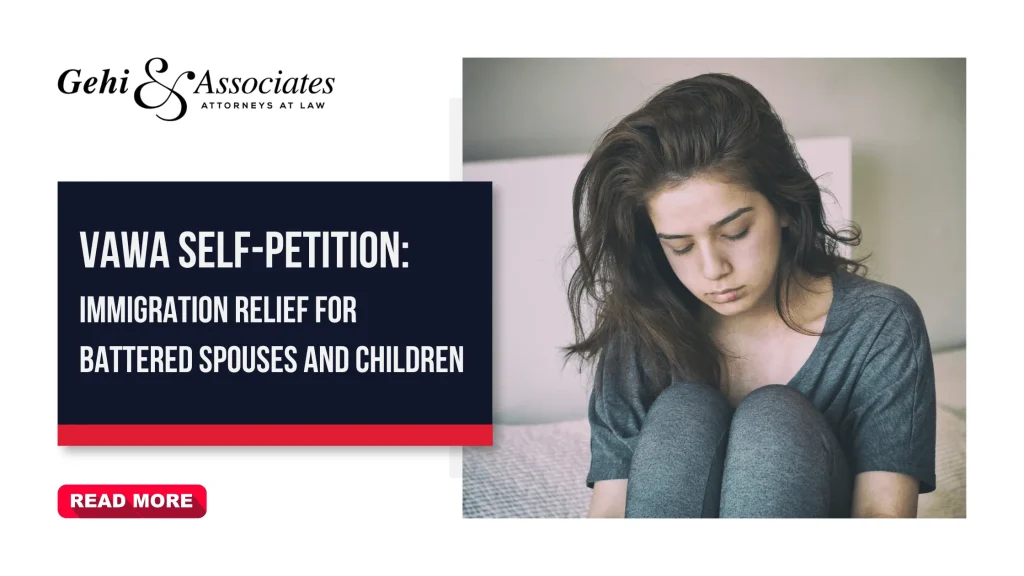
Abuse should never be the reason a person stays trapped in an immigration status that depends on the abuser. Congress understood that problem when it passed the Violence Against Women Act. The law gives survivors a way out.
Under VAWA, a battered spouse, child, or parent can self-petition for immigration status without their abuser’s knowledge or cooperation. The abuser is never contacted by USCIS. The case is kept strictly confidential at every stage.
This guide explains the VAWA self-petition battered spouse process from start to finish. It covers VAWA eligibility, evidence, timing, and where a VAWA attorney NYC based makes the case stronger.
What VAWA Is
VAWA is a federal law that creates a path to lawful status for non-citizens who have suffered abuse by certain US citizen or lawful permanent resident relatives.
It is one of the strongest forms of domestic violence immigration relief in US law. It removes the abuser from the equation entirely. The survivor controls the case.
Despite the name, VAWA is not limited to women. Men, children, and elderly parents can also file. The protection follows the harm, not the gender.
Why This Relief Exists
Before VAWA, an abused non-citizen spouse had a terrible choice. They could stay with the abuser and keep their immigration status. Or they could leave and lose everything.
Abusers knew this dynamic and exploited it. Many used immigration as another tool of control. “If you leave, I will have you deported.” The threat kept people in danger for years on end.
VAWA broke that trap. By offering domestic violence immigration relief that does not require the abuser, the law took away one of the most powerful weapons of coercive control.
Who Can File a Self-Petition
VAWA self-petitions are available to three groups of family members.
- The spouse or former spouse of an abusive US citizen or lawful permanent resident.
- The child, under 21 and unmarried, of an abusive US citizen or lawful permanent resident parent.
- The parent of an abusive adult US citizen son or daughter.
A battered spouse can also include their unmarried children under 21 as derivative beneficiaries. The protection extends through the family unit where it can.
VAWA Eligibility Requirements
To establish VAWA eligibility as a battered spouse, the applicant has to meet several requirements at the same time.
- A qualifying relationship with the abuser, current or recent.
- The abuser was a US citizen or lawful permanent resident during the marriage.
- The applicant was subjected to battery or extreme cruelty during the marriage.
- The applicant entered the marriage in good faith, not solely for immigration benefits.
- The applicant resided with the abuser at some point.
- The applicant has good moral character.
“Battery or extreme cruelty” is broader than physical violence alone. It can include emotional abuse, threats, intimidation, financial control, and coercive conduct of many kinds.
What Counts as Battery or Extreme Cruelty
USCIS reads this term generously when the evidence supports it. Recognised forms of abuse include physical violence, sexual abuse, and threats of harm.
Less obvious examples also qualify. Forced isolation from family. Destruction of immigration documents. Threats of deportation as a tool of control. Withholding food or medical care. The pattern matters as much as any single act.
How The Self-petition Process Works
Step 1 — File Form I-360
The case begins with Form I-360 under the VAWA category. There is no filing fee for the I-360 or for most related forms filed through final adjudication.
All VAWA self-petitions go to the USCIS Nebraska Service Center’s HART unit. The HART team handles humanitarian cases with trained, specialised officers.
Step 2 — Build the Evidence Package
VAWA cases are won or lost on the evidence. USCIS expects a coherent story backed by independent documents wherever they can be safely obtained.
Common evidence includes police reports, restraining orders, medical records, photographs of injuries, witness affidavits, and the petitioner’s own detailed personal declaration. Quality matters far more than volume.
Step 3 — Prima Facie Determination
If the petition shows basic eligibility on its face, USCIS issues a prima facie determination notice. This notice gives access to certain public benefits while the case is pending.
Prima facie is not a final approval. It is an early signal that the file looks credible. The full adjudication continues afterward.
Step 4 — Deferred Action and Work Authorisation
Approved self-petitioners are eligible for an Employment Authorisation Document. Many filers request the EAD on the I-360 itself or apply later with Form I-765.
USCIS may also grant deferred action to a pending VAWA self-petitioner. Deferred action gives temporary protection from removal while the case is decided.
Step 5 — Adjustment of Status
Self-petitioners with an abusive US citizen relative are immediate relatives. They can usually file Form I-485 for adjustment of status concurrently with the I-360.
Spouses of lawful permanent residents must wait for a visa number to become available before filing the I-485. The Visa Bulletin governs the timing for that category.
Timing and Processing in 2026
VAWA cases are not fast. As of 2026, the I-360 alone averages around three and a half to four years for 80% of cases at the Nebraska HART unit.
Adjustment of status adds more time after I-360 approval. The total path from filing to green card in hand commonly runs four to five years.
Filing properly is the single biggest thing you can do to keep your case on the shorter side of that range. Errors and weak evidence draw RFEs that extend the wait by months. A well-prepared file moves through the queue faster.
Confidentiality is the Law
VAWA confidentiality is one of the strongest protections in immigration law. USCIS cannot make adverse decisions based on information provided by the abuser.
This makes VAWA different from almost every other form of domestic violence immigration relief. The survivor is the only one in the room with USCIS. The abuser has no say in the case.
USCIS will not contact your abuser. They will not share your address, your filing, or your status. The address you list on the petition should be safe and reliable for receiving mail.
Many survivors use a trusted relative’s address, a lawyer’s office, or another secure mailing option. Pick somewhere your abuser cannot access. This is a real safety question, not a technicality.
Increased Scrutiny in 2026
USCIS tightened evidentiary requirements for VAWA self-petitions in a December 2025 Policy Manual update. Officers are now instructed to scrutinise affidavits for templated or recycled content.
The eligibility categories did not change. The story still has to be the petitioner’s own, in their own voice. Generic affidavits invite RFEs and denials.
Strong files include detailed, specific narratives. They include corroborating documents wherever they can be safely obtained. They explain gaps in evidence clearly.
Common Pitfalls
- Filing without a detailed personal declaration in the petitioner’s own words.
- Submitting generic affidavits that read like a template.
- Mailing notices to an unsafe address.
- Failing to document the qualifying relationship — marriage certificate, photos, leases, joint accounts where they exist.
- Hiding earlier inconsistencies in prior immigration filings instead of explaining them.
- Waiting until the abuser files something against the survivor before acting.
Why You Need a VAWA Attorney NYC
VAWA cases require both legal precision and a careful, human approach. A VAWA attorney NYC based combines both.
A VAWA self-petition battered spouse case is rarely the only legal question on the table. Many survivors also face family court matters, protective orders, criminal proceedings, or housing concerns. A good lawyer maps the immigration case to the rest of life.
They draft the declaration with the survivor, not at them. They help gather records without putting the petitioner at greater risk. They prepare for RFEs before USCIS sends one.
They also coordinate with shelter advocates, therapists, and family law counsel where needed. VAWA work sits at the intersection of immigration, family safety, and trauma. Experience with this exact mix matters more than most clients realise.
Confidential Consultation
If you have been hurt by a US citizen or green card holder spouse, parent, or adult child, you may have options under VAWA. The first step is information you can trust.
Book a confidential consultation with our team at Gehi and Associates. We will listen with care, review your situation in private, and tell you honestly whether VAWA fits. Your safety comes first throughout the conversation.
Contact us today!
Frequently Asked Questions:
How long does the VAWA self-petition battered spouse process take?
As of 2026, the I-360 alone averages roughly three and a half to four years for the majority of cases. Adjustment of status can add another year or two. Plan for a multi-year process and use the early benefits.
Will my abuser find out that I filed?
No. VAWA confidentiality is built into federal law. USCIS will not contact your abuser. The case stays private throughout the process. Choose a safe mailing address to protect that confidentiality.
Can men file under VAWA?
Yes. VAWA applies to anyone who has been abused by a qualifying US citizen or lawful permanent resident relative. Gender is not a barrier. The protections follow the harm.
What if I am already divorced from the abuser?
You may still qualify if the divorce was connected to the abuse and the petition is filed within two years of the divorce. The qualifying relationship existed during the marriage.
Does the abuse have to be physical?
No. Battery or extreme cruelty covers emotional abuse, threats, financial control, isolation, and many other coercive patterns. Document the conduct in detail in your declaration.
Can I work in the United States while my case is pending?
In most cases, yes. Self-petitioners may be granted deferred action and an Employment Authorisation Document while their case is pending. The EAD provides legal work permission for the duration of the wait, which can be long.
What if my abuser is undocumented?
VAWA requires the abuser to have been a US citizen or lawful permanent resident during the marriage. If neither applies, VAWA itself may not fit. Other forms of relief, including the U visa, may be available.
Can my children get protection through my VAWA case?
Yes, in many cases. Unmarried children under 21 of a battered spouse can be included as derivative beneficiaries. They share in the protection and the path to a green card.
What is a prima facie determination?
It is an early notice from USCIS that your petition shows basic eligibility. It does not approve the case. It does give access to certain public benefits while the case is pending.
Is there a filing fee for the VAWA petition?
Most VAWA-based forms have no government filing fee through final adjudication of the green card. Always confirm the current fee schedule with USCIS or counsel before filing anything.
Related Posts
Free Consultation
For Faster Response
We are Available 24/7
Our law offices in NY offer free virtual and in-person consultations for all legal and immigration matters. To schedule one, please get in touch with us today!